
A compliant fragrance order is a paper trail before it is a product: certificates that prove the factory's system, batch records that prove the run, tests that prove the formula and notifications that prove the market. A first-time founder who lists these documents before signing turns the compliance conversation from an emergency into a checklist, and the difference is usually weeks of delay and avoided fines. The pack you should collect is smaller than people think — about ten documents — and most of them already exist in an export factory's files.
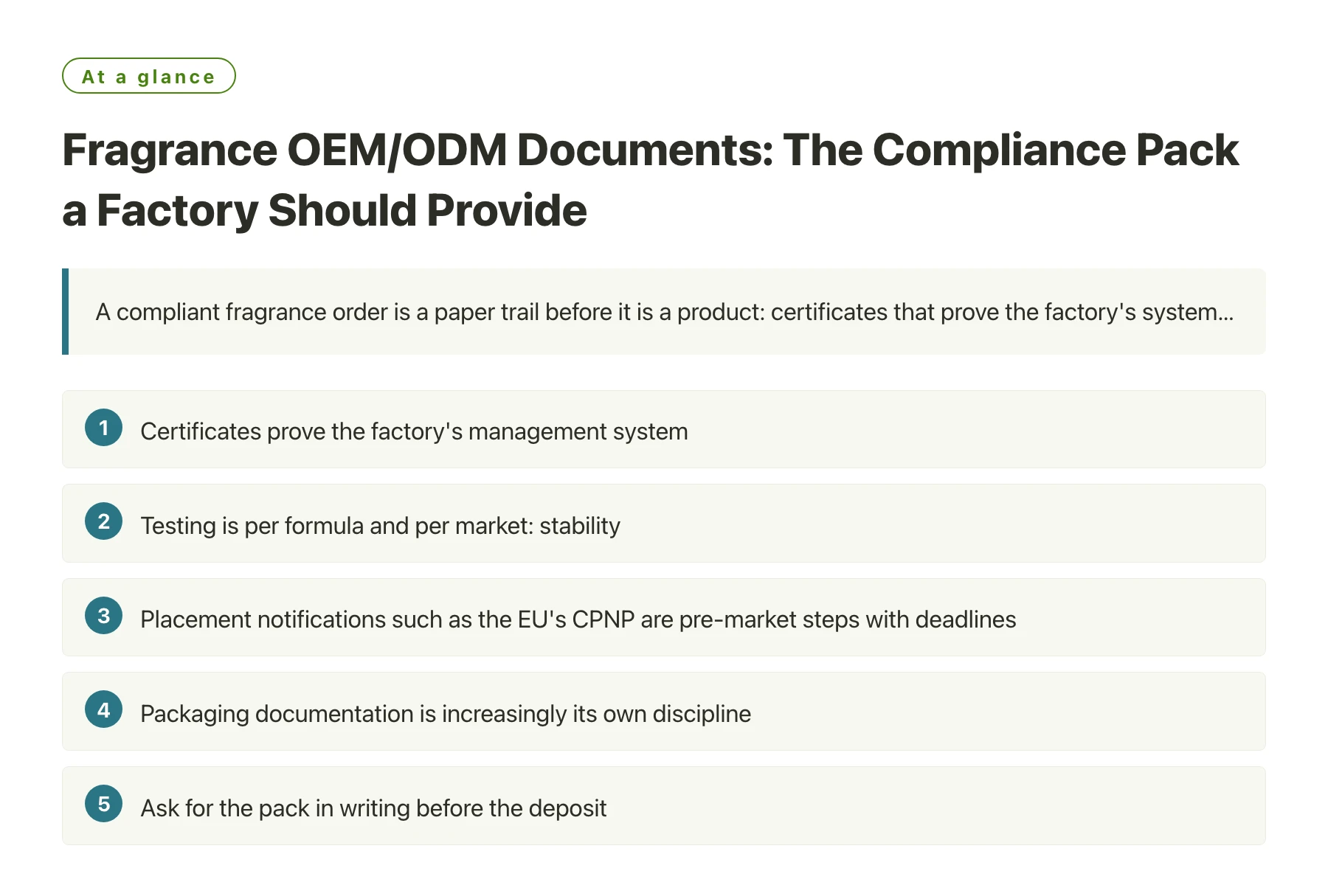
Key takeaways
- Certificates prove the factory's management system; batch records prove what happened on your specific run — collect both because they answer different questions.
- Testing is per formula and per market: stability, safety assessment and micro claims follow the destination rulebook, not the factory's pride.
- Placement notifications such as the EU's CPNP are pre-market steps with deadlines; missing one can pause a launch.
- Packaging documentation is increasingly its own discipline, with EU packaging rules tightening the scope for reuse and overpackaging.
- Ask for the pack in writing before the deposit; suppliers with export experience quote it as a standard deliverable.
Most founders discover compliance the hard way: the first container is packed, and the new market's importer asks for a document that exists only in the factory's imagination.
This article lists the documents a fragrance OEM/ODM project realistically generates, what each one proves and when you actually need it — so you can ask for the pack in the first email instead of the last.
The two layers of documentation
Compliance documents split into two layers. The factory layer proves the system: management-system certificates, facility licences, GMP credentials. The product layer proves the formula: ingredient lists, safety assessments, stability and notification records. Founders who conflate the two get burned, because a gorgeous factory certificate does not make a single formula legal [1].
A cosmetics product placed on the EU market, for example, must satisfy the EU cosmetics regulation as a whole — ingredient legality, labelling, safety assessment, notification — and none of those are factory documents [1]. A manufacturer's own published record is where your file starts: its background and certifications states what the company claims, and every item on it still needs verification.
The pack, document by document
| Document | What it proves | When you need it |
|---|---|---|
| Management-system certificate (ISO 22716 / GMPC) | The factory's production system meets a recognised cosmetics GMP | Before the audit conversation, and again with the signed contract |
| Batch record | The specific run was made to spec, from intake to release | Pilot approval and every repeat order |
| IFRA compliance statement | Fragrance materials within the industry's usage limits | With the final sample |
| Ingredient list per market | Formula contents for the destination rulebook | Before notification and labelling |
| Stability report | The formula holds under storage and transport conditions | Before committing to packaging volumes |
| Safety assessment | A qualified assessor reviewed the formula for the market | Before first sale in that market |
| Notification or registration (such as CPNP) | The market authority has the product on file | Before placing on the market |
| Packaging compliance file | Materials and format meet the packaging rules for the market | With the packaging order |
Read the third column as a calendar: most items are needed before you can sell, which means they must be commissioned before you order packaging.
The documents specific to your market
The EU pack includes the safety assessment and a notification through the CPNP portal before marketing. Canada runs its own regime: cosmetics sold there must be notified to Health Canada within ten days of first sale [2].
Packaging adds its own layer: the EU is progressively tightening its packaging rules, including requirements around reuse and overpackaging, so packaging compliance is a document you will be asked for sooner than you expect [3].
Collecting the pack in five moves
- Ask for the full list in writing, pre-depositA short email suffices: please send the document list your standard export pack includes for my market.
- Match the pack to the marketCross out what does not apply and flag what is missing — the gap list is your negotiating table.
- Put the deliverables in the contractEvery document has an owner and a date; the batch record and the stability report belong to each run.
- Review the templates before the orderSeeing a blank batch record template tells you whether the system will produce evidence you can actually read.
- Re-run the checklist per marketA second market is a second pack; treat it as a new compliance project rather than an attachment to the first.
Why the supplier's record matters
The speed of every step depends on how practised the factory is at producing these documents. A supplier that exports widely will hand you a standard pack from day one; a supplier new to your market will learn the rules at your expense. That asymmetry is exactly why the document conversation belongs before the money conversation — third-party labs that audit cosmetics GMP will tell you the same thing: documentation is the difference between a system and a story [4].
The order of the two questions is fixed: documents first, samples second, volumes third. Founders who reverse the order spend the whole first year apologising to importers. If the route is OEM, your partner manufactures to your specification, so the documentation question is sharper still: an an OEM partner for perfume brands that cannot produce its own process records cannot document yours either.
A manufacturer offering a full Xuelei fragrance OEM/ODM operation will already hold most of this pack for its export lines — the question is whether it hands them over before you pay, and how cleanly the batch records are kept after.
Never pay a compliance invoice you were not told about. Documents are not a surprise line item: if the pack list is not in the quotation, the quotation is incomplete.
Sources
- European Commission: Cosmetics in the EU —— The European Commission's overview of EU cosmetics rules, including the responsible person, product information file and safety report requirements.
- Health Canada: Cosmetic Safety —— Health Canada's cosmetics pages, covering cosmetic notification, the ingredient hotlist and safety requirements for cosmetics sold in Canada.
- European Commission: Packaging Waste and the PPWR —— EU rules on packaging and packaging waste, including the Packaging and Packaging Waste Regulation requirements on recyclability and design.
- SGS: Cosmetics, Personal Care & Household Testing —— Testing, inspection and certification services for cosmetics and personal care, including microbiological, stability and safety testing aligned with cosmetics GMP.
Frequently asked questions
Which documents do I absolutely need for my first perfume order?
The short list: management-system certificate, batch record, IFRA compliance statement, ingredient list, stability report, safety assessment and the market notification. Add packaging compliance where the destination requires it.
What is CPNP?
The European Commission's Cosmetic Products Notification Portal. Products placed on the EU market must be notified there before sale, based on the responsible person's file. It is a pre-market step with a deadline, not an afterthought.
Who writes the safety assessment?
A qualified safety assessor — a person or laboratory with the recognised credentials — reviews the formula against the regulation. It is per-formula, per-market work, so the cost repeats for each product you launch.
Does my factory provide the stability report?
Usually the factory or its lab runs the study and issues the report, but define the study scope in the contract — time points, conditions and who owns the data. Owning the data matters when you change suppliers.
How long does the paperwork take?
Weeks, not days, and it runs in parallel with packaging if planned. The realistic danger is not the total time but starting late; the pack clock starts at the frozen sample, so commissioning documents at the sampling stage keeps the launch date.